
Beginner's Guide to Artificial Intelligence and Machine Learning

Beginner's Guide to Artificial Intelligence and Machine Learning
Artificial Intelligence (AI) and Machine Learning (ML) have become two of the most talked-about technologies of the modern era. From voice assistants and recommendation systems to self-driving cars and medical research, these technologies are transforming the way we live and work.
Despite their growing popularity, many people are still unsure what AI and Machine Learning actually mean or how they differ.
This beginner-friendly guide explains the basics, explores real-world applications, and highlights why these technologies matter in today's digital world.
What Is Artificial Intelligence (AI)?
Artificial Intelligence is a branch of computer science focused on creating systems that can perform tasks that typically require human intelligence.
These tasks include:
- Understanding language
- Recognizing images and objects
- Solving problems
- Making decisions
- Learning from experience
- Translating languages
Rather than simply following fixed instructions, AI systems can analyze information and respond intelligently to different situations.
What Is Machine Learning (ML)?
Machine Learning is a subset of Artificial Intelligence.
Instead of being explicitly programmed for every task, Machine Learning systems learn by analyzing data and identifying patterns.
The more quality data they process, the better they often become at making predictions or decisions.
In simple terms:
- Artificial Intelligence is the broader concept of machines performing intelligent tasks.
- Machine Learning is one method used to build AI systems.
How Does Machine Learning Work?
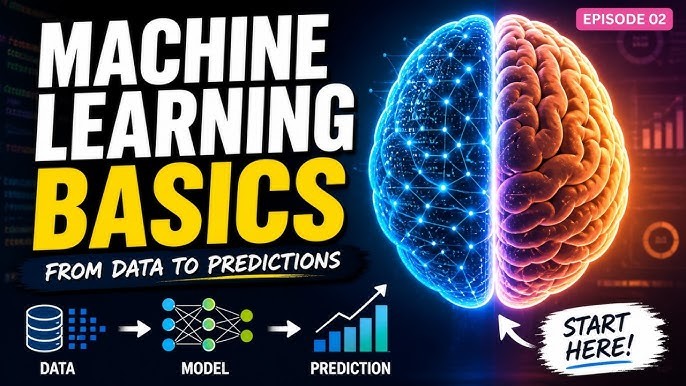
Machine Learning generally follows these steps:
- Data is collected.
- The data is cleaned and prepared.
- A machine learning model is trained using the data.
- The model learns patterns and relationships.
- The trained model makes predictions or decisions on new data.
- The model can be improved with additional data and evaluation.
This process enables computers to improve their performance over time without requiring manual programming for every scenario.
Types of Machine Learning
1. Supervised Learning
The model learns from labeled data where the correct answers are already known.
Example:
Teaching a computer to recognize emails as either "spam" or "not spam."
2. Unsupervised Learning
The model analyzes unlabeled data to discover hidden patterns or group similar items together.
Example:
Grouping customers based on purchasing behavior.
3. Reinforcement Learning
The model learns by interacting with an environment and receiving rewards or penalties based on its actions.
Example:
Training robots or game-playing AI systems.
Real-World Applications of AI and Machine Learning
AI and Machine Learning are used in many industries.
Examples include:
Healthcare
- Medical image analysis
- Disease prediction
- Drug discovery
- Virtual health assistants
Finance
- Fraud detection
- Credit scoring
- Investment analysis
- Risk assessment
Retail
- Product recommendations
- Customer behavior analysis
- Inventory management
- Demand forecasting
Agriculture
- Smart irrigation
- Crop disease detection
- Yield prediction
- Livestock monitoring
Transportation
- Route optimization
- Predictive maintenance
- Traffic management
- Driver assistance systems
Education
- Personalized learning
- Automated grading
- Intelligent tutoring systems
Benefits of AI and Machine Learning
Organizations increasingly adopt AI because it can help:
- Automate repetitive tasks
- Improve productivity
- Reduce human errors
- Support better decision-making
- Analyze large amounts of data quickly
- Enhance customer experiences
For businesses, these advantages can improve efficiency and competitiveness.
Challenges and Limitations
While AI offers many benefits, it also has limitations.
Some common challenges include:
- Data privacy concerns
- Algorithm bias
- High development costs
- Dependence on quality data
- Ethical considerations
- Cybersecurity risks
Understanding these challenges is important for responsible AI adoption.
Will AI Replace Human Jobs?
AI is changing many workplaces by automating routine tasks.
However, it is also creating new opportunities in areas such as:
- AI development
- Data science
- Cybersecurity
- Machine learning engineering
- Robotics
- AI ethics
- Digital transformation consulting
Many experts believe AI is more likely to change the nature of work than replace all human jobs.
Skills such as creativity, communication, leadership, and critical thinking remain highly valuable.
How to Start Learning AI and Machine Learning
If you're interested in entering the field, consider learning:
- Basic computer skills
- Programming (especially Python)
- Mathematics and statistics
- Data analysis
- Machine learning concepts
- Cloud computing
- AI ethics
Hands-on practice through projects is one of the best ways to build practical knowledge.
The Future of AI
Artificial Intelligence continues to evolve rapidly.
Future developments may include:
- Smarter virtual assistants
- More advanced healthcare technologies
- Improved automation
- Autonomous transportation
- Intelligent manufacturing
- Personalized education
- Smarter agriculture
As AI becomes more integrated into daily life, understanding its fundamentals will become increasingly valuable.
Final Thoughts
Artificial Intelligence and Machine Learning are no longer technologies of the future—they are already shaping industries around the world.
While the concepts may seem complex at first, understanding the basics provides a strong foundation for exploring one of today's most exciting fields.
Whether you're a student, entrepreneur, developer, or business owner, learning about AI and Machine Learning can help you better understand the technologies influencing the future of work, business, and everyday life.
Frequently Asked Questions
What's Your Reaction?
 Like
0
Like
0
 Dislike
0
Dislike
0
 Love
0
Love
0
 Funny
0
Funny
0
 Wow
0
Wow
0
 Sad
0
Sad
0
 Angry
0
Angry
0










Comments (0)