
What Businesses Should Know About Quantum Computing

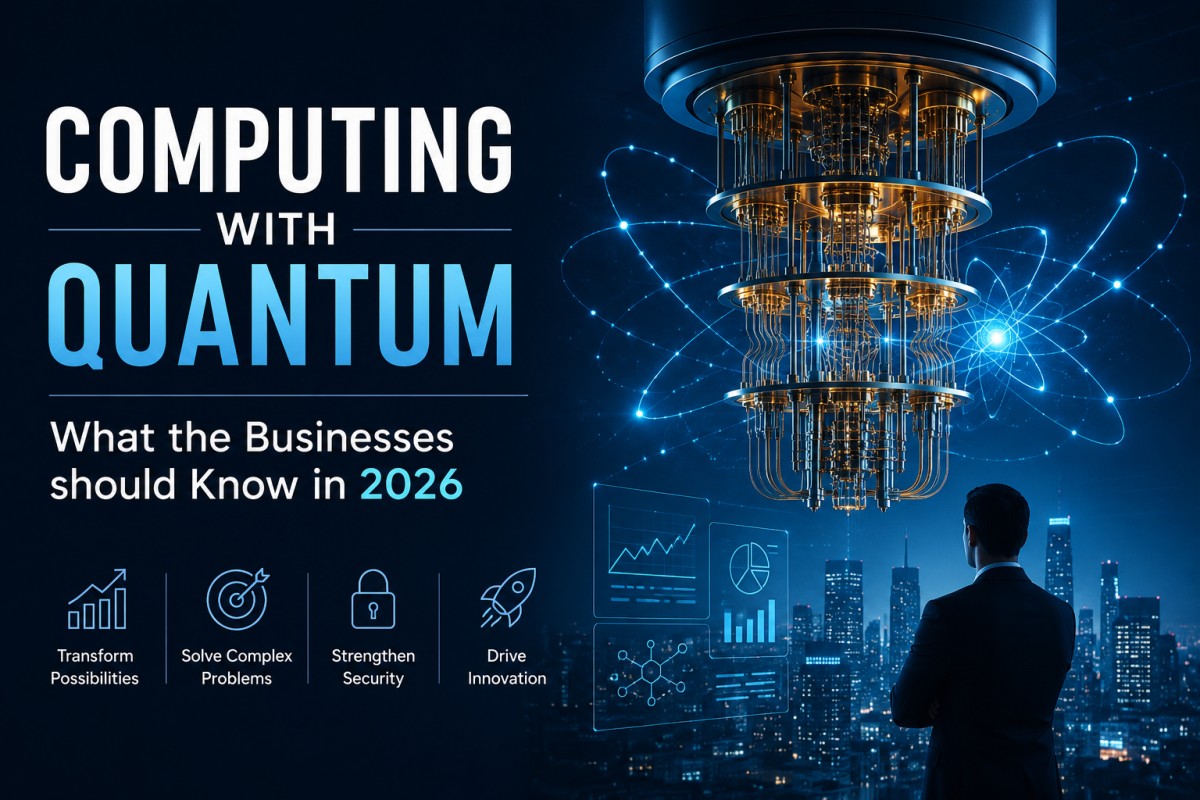
What Businesses Should Know About Quantum Computing
For decades, quantum computing was considered a topic reserved for scientists and research laboratories. Today, however, it is gradually moving closer to real-world business applications. While the technology is still developing, organizations across industries are paying attention because of its potential to solve problems that are difficult—or even impossible—for traditional computers.
Business owners don't need to become quantum physicists, but understanding the basics of quantum computing can help them prepare for future technological changes and identify opportunities for innovation.
What Is Quantum Computing?
Quantum computing is a new type of computing that uses the principles of quantum mechanics to process information.
Unlike traditional computers, which use bits that can only be either 0 or 1, quantum computers use qubits. A qubit can represent multiple states simultaneously through a property known as superposition. Combined with another quantum property called entanglement, this allows quantum computers to perform certain calculations much more efficiently than classical computers.
It's important to note that quantum computers are not designed to replace everyday laptops or office computers. Instead, they are built to solve highly complex problems that would take conventional computers an extremely long time to process.
Why Should Businesses Care?
Although widespread commercial use is still evolving, quantum computing has the potential to transform industries by enabling faster analysis, improved optimization, and more advanced simulations.
Businesses that stay informed today may be better positioned to adopt practical quantum solutions as they become more accessible.
Potential Business Applications
1. Supply Chain Optimization
Managing complex supply chains involves balancing transportation routes, inventory levels, production schedules, and delivery timelines.
Quantum computing could help businesses evaluate countless possible scenarios to identify more efficient logistics strategies, potentially reducing costs and improving delivery performance.
2. Financial Services
Banks and financial institutions constantly analyze risks, investment portfolios, and market trends.
Quantum computing may improve:
- Portfolio optimization
- Risk analysis
- Fraud detection
- Financial forecasting
- Market simulations
These capabilities could lead to more informed decision-making.
3. Drug Discovery and Healthcare
Developing new medicines often requires simulating complex molecular interactions.
Quantum computing could significantly accelerate research by modeling chemical structures more accurately, helping researchers identify promising treatments more efficiently.
4. Manufacturing
Manufacturers may use quantum computing to:
- Improve production planning
- Optimize factory operations
- Design stronger materials
- Reduce manufacturing costs
- Enhance quality control
These improvements could increase productivity and operational efficiency.
5. Artificial Intelligence and Machine Learning
Quantum computing may eventually complement Artificial Intelligence by processing large datasets more efficiently and solving optimization problems that challenge today's computing systems.
Although this field is still developing, researchers continue to explore how quantum algorithms might support future AI applications.
Benefits for Businesses
As quantum technology matures, businesses could benefit from:
- Faster problem-solving
- Improved operational efficiency
- Better decision-making through advanced analytics
- More accurate simulations
- Enhanced innovation opportunities
- Competitive advantages in research-intensive industries
The exact benefits will depend on each organization's industry and specific use cases.
Current Challenges
Despite its promise, quantum computing still faces several challenges.
High Costs
Building and maintaining quantum computers requires specialized equipment and highly controlled environments.
Limited Availability
Most businesses do not own quantum computers. Access is typically provided through research institutions or cloud-based quantum computing services.
Technical Complexity
Developing quantum software requires expertise in mathematics, physics, and specialized programming approaches.
Error Rates
Quantum systems remain sensitive to environmental interference, making error correction an active area of research.
Will Quantum Computing Replace Traditional Computers?
No.
Traditional computers remain the best choice for everyday tasks such as:
- Email
- Word processing
- Accounting
- Web browsing
- Customer management
- Office productivity
Quantum computers are designed for specialized computational challenges rather than general-purpose computing.
In the future, organizations are likely to use both technologies together, with each handling the tasks it performs best.
Preparing Your Business for the Quantum Era
While widespread adoption may still take time, businesses can begin preparing by:
- Following developments in quantum technology.
- Investing in digital transformation initiatives.
- Strengthening cybersecurity practices.
- Training employees in emerging technologies.
- Exploring cloud-based quantum computing services for research and experimentation.
Being informed today can help businesses adapt more effectively as the technology evolves.
The Cybersecurity Impact
One of the most discussed aspects of quantum computing is its potential effect on cybersecurity.
Some current encryption methods could eventually become vulnerable to sufficiently powerful quantum computers. As a result, researchers and technology companies are developing post-quantum cryptography, which aims to protect digital information against future quantum-based attacks.
Businesses should monitor developments in cybersecurity standards and update their systems as new recommendations become available.
Is Quantum Computing Relevant for Small Businesses?
For many small businesses, quantum computing may not have an immediate impact on daily operations.
However, small businesses can still benefit by understanding the technology and watching for future services that become affordable through cloud platforms.
As happened with cloud computing and Artificial Intelligence, advanced technologies often become more accessible over time.
The Future of Quantum Computing
Experts expect quantum computing to continue advancing over the coming years, though widespread commercial adoption will likely occur gradually.
Future developments may include:
- Faster optimization algorithms
- Improved logistics planning
- More accurate scientific simulations
- Enhanced financial modeling
- New discoveries in healthcare and materials science
- Stronger cybersecurity technologies
As research progresses, quantum computing may become an important tool for solving some of the world's most complex computational challenges.
Final Thoughts
Quantum computing is still an emerging technology, but its long-term potential is significant. While it is unlikely to replace traditional computers, it could revolutionize industries that rely on solving highly complex problems.
For business leaders, the most important step today is not rushing to adopt quantum computing but understanding its possibilities and monitoring its development. Organizations that remain informed and adaptable will be better prepared to take advantage of new opportunities as quantum technologies mature.
Frequently Asked Questions
What's Your Reaction?
 Like
2
Like
2
 Dislike
0
Dislike
0
 Love
1
Love
1
 Funny
0
Funny
0
 Wow
1
Wow
1
 Sad
0
Sad
0
 Angry
0
Angry
0









Comments (0)